

by Richard Uhlhorn
DDT LOADING STUDY:
Clay Patmont, Anchor QEA, LLC, told the Watershed Planning Committee that Lake Chelan still has the highest concentration of DDT in the nation.
DDT (dichloro-diphenyl-trichloroethane), developed as the first of the modern synthetic insecticides in the 1940s, was used extensively in Lake Chelan Valley orchards from the 1940s to 70s. An estimated 80,000 kilograms (140,800 ibs.) of DDT was applied to some 12,000 acres over the years. “There was a lot of DDT applied,” said Patmont.
The Toxics Control Demonstration study in 2010 and 2021 found no DDT levels declining. The study sampled lake trout for DDT levels which was used to determine the level of DDT in the lake.

Sources of this contamination comes from ongoing leaching of the material in orchard soils to the lake from orchard drains, groundwater and creek drainages.
Patmont stated that natural recovery would not achieve risk reduction goals for at least 100 years, but directing drainages through wetlands (Dry Lake) could substantially reduce DDT loading by 70 to 95 percent.
With a $1.3 million dollar grant from the Department of Ecology, the plan is to 1. – characterize current DDT loading into the lake in 2025; construct a one to two acre prototype wetland in 2026; monitor the wetland’s effectiveness in 2027 and 2028; and if successful; expand wetland treatments in the entire basin where it was applied.
Quagga/Zebra Mussel concerns:
“It has never been more important for people to stay alert,” said Stephen Lesky. This comment came during a report on Quagga mussels being detected in the Columbia River Basin and the potential of this invasive species being introduced in Lake Chelan.
Multiple occurrences have been noted in the Twin Falls, Idaho area where 375 miles of river dumps into the Columbia River.
Quagga and Zebra mussels are species that can cause millions of dollar’s worth of damage if allowed to attach and grow in water passage ways, irrigation canals, dams and fish hatcheries. The economic impact is estimated at $100 million per year.
The Washington State Fish and Wildlife Service has five primary boat inspection stations for vessels crossing into the state. “We are trying to protect Washington waters,” said Bush.
Currently the state is free of quagga mussels. “When we find an occurrence there will be a rapid response.”
Stephen Lesky, manager of Lake Chelan’s boat inspection program, said, “We are seeing an increase on boats on Lake Chelan.” The Lake Chelan Boat Inspection Program is in its second year on a grant from the National Park Service. “People appreciate what we are doing with the program.”

“We are excited about what you are doing,” said Bush.
Bush described another major concern with zebra mussels that are showing up in moss balls being sold to pet stores. “There are 22 wholesalers that have received contaminated products in Washington. Ultimately, we know it is an ongoing problem.”
Fish and Wildlife has received $1.8 million in State funding and another $1.83 million in Federal funding to combat the potential influx of invasive species to Washington waterways. The WDFW Response Team has met with 27 retailers and are taking significant steps to stop the importation of zebra mussels in moss balls to pet stores. “We are planning for the worst case scenario.”
Water Quality – Phil Long

“We had a busy summer,” said Long. “Things look fairly normal.” However there is ongoing concern with the algae growth on rocks and docks in the near shore areas of the Wapato Basin. The Lake Chelan Research Institute is hoping to identify the different species that are present.
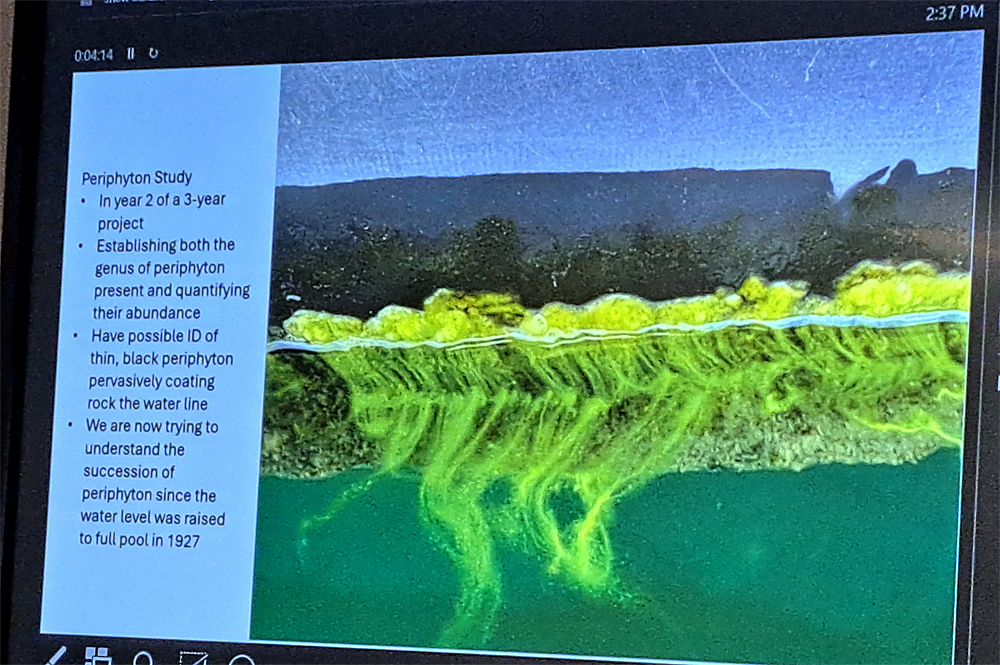
Long stated that the Institute is in the second year of a three year study funded by the PUD. “This is not what you want growing on our shores and docks,” said Long.
Water rights:
Ecology continues to work with RH2 Engineers on water right applications and reported that seven more property owners have received their certificates. “We are moving forward.”
Round Table:

Fishery Forum… PUD will give an update in December
NPS is conducting temperature monitoring and creel surveys.
Mike Kaputa reported that the committee should have a report on the reintroduction of bull trout December. A draft manuscript has been circulated for peer review amongst the committee members.
The next meeting will be in December.




 All Things Lake Chelan